
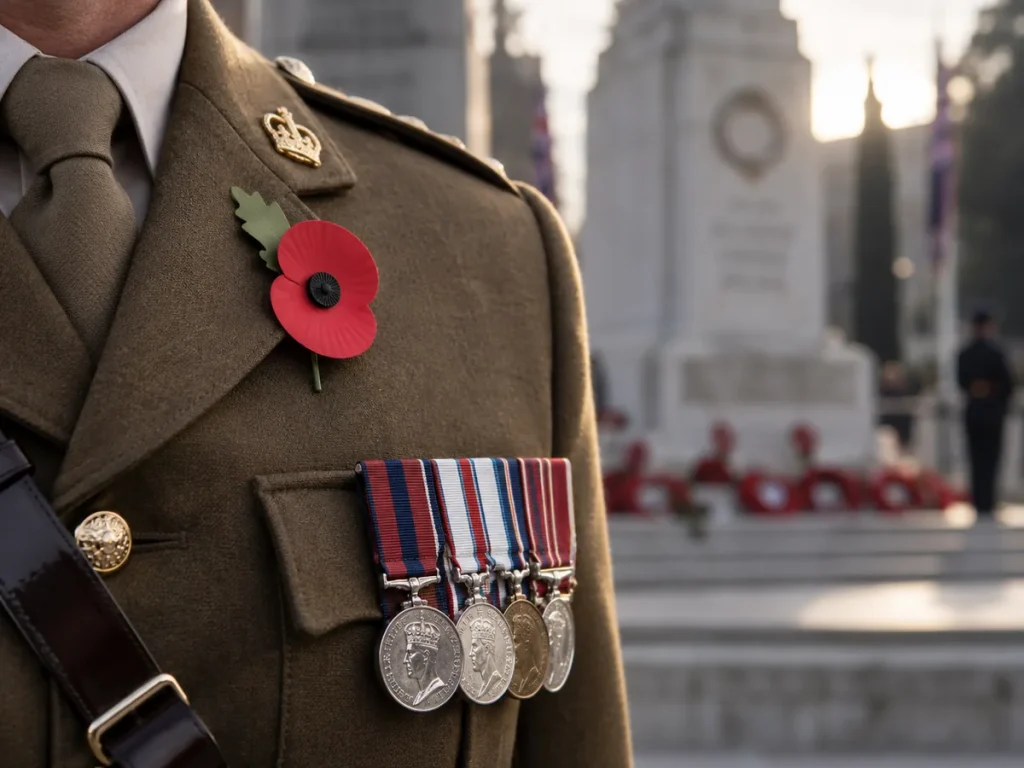
Every autumn, from late October until the second week of November, millions of people across the United Kingdom pin a small red poppy to their coats. Many Americans know the sight but not the story behind it.
The Remembrance poppy is one of the most recognized symbols in the world, and the poppy pin, whether paper, metal or enamel, is how most people wear it. In this guide we look at where the tradition comes from, how the Royal British Legion’s Poppy Appeal works, the main enamel poppy pin styles you’ll come across, and what organizations should know before commissioning their own custom remembrance pins.
Where the Remembrance poppy comes from
The fields of Flanders
The story starts on the Western Front during the First World War. Red field poppies grew in the churned-up soil of northern France and Belgium, and they became a powerful image for the soldiers who fought there. In 1915, Canadian army doctor Lieutenant Colonel John McCrae wrote the poem “In Flanders Fields,” which opens with the line “In Flanders fields the poppies blow / Between the crosses, row on row.” The poem was widely read and helped fix the poppy in the public mind as a symbol of those who died in the war.
Two women who turned a poem into a movement
According to the Royal British Legion (RBL), two women were central to the poppy becoming a symbol of Remembrance:
- Moina Michael, an American academic from Georgia, was moved by McCrae’s poem. On November 9, 1918, two days before the Armistice, she wrote her own reply, “We Shall Keep the Faith,” and resolved to always wear a red poppy. She then campaigned for it to become a national memorial symbol. The American Legion designated the red poppy as its official flower in 1920, according to the University of Georgia.
- Anna Guérin, a French lecturer, promoted artificial poppies made by French women to raise money for the devastated regions of France. In 1921 she visited the newly founded British Legion and asked it to adopt the poppy as a way to raise funds.
The Royal British Legion and the first Poppy Appeal
The British Legion was formed on May 15, 1921, bringing together several organizations of ex-servicemen. (It became the Royal British Legion in 1971.) After meeting Anna Guérin, the Legion agreed to sell poppies, and the first Poppy Day was held on November 11, 1921.
The poppies sold out almost immediately. The RBL says that first appeal raised more than £100,000, money used to help veterans with housing and jobs. That was an enormous sum at the time, and it established the Poppy Appeal as an annual event.
The Poppy Factory
The Legion soon wanted its poppies made in Britain. In 1922, Major George Howson MC, a First World War officer, founded the Poppy Factory with a grant from the Legion. According to the Poppy Factory, it opened in June 1922 near the Old Kent Road in south London and employed veterans who had been wounded in the war. The factory later moved to Richmond.
England’s two petals, Scotland’s four
If you look closely, not every Remembrance poppy is the same. Lady Haig’s Poppy Factory was founded in Edinburgh in 1926 to make poppies for Scotland. Lady Haig designed a four-petal poppy with no leaf, which is considered more botanically correct, while the poppies made for the rest of the UK have two petals and a green leaf. Poppyscotland notes that the difference remains today.
The RBL notes that the original emblem had no leaf; the leaf was introduced in the 1960s.
The poppy today
The Poppy Appeal still runs every year in the weeks before Remembrance Sunday (the second Sunday in November) and Armistice Day on November 11, when many people observe a two-minute silence at 11 a.m. Money raised supports serving personnel, veterans and their families.
The poppy itself has changed too. In 2023 the RBL introduced its first plastic-free poppy, made from recyclable paper, with a black center embossed “Poppy Appeal.” BBC News reported that it was the first change to the design in 28 years.
Paper poppy vs. poppy pin: what people actually wear
The classic paper poppy is given in exchange for a donation and is meant to be worn for the season. But paper poppies are fragile, and many people look for something they can wear year after year. That is where the poppy pin comes in.
The RBL’s official Poppy Shop (poppyshop.org.uk) sells enamel poppy pins and badges, including ridged enamel badges, pins with crystal centers and magnetic lapel badges, with profits supporting the Armed Forces community.
For organizations, from regimental associations and veterans’ groups to companies with employee networks of former service members, a custom remembrance pin can be a way to mark the season with their own identity.
Enamel poppy pin styles
Most metal poppy pins fall into a handful of styles. Each can be made in different sizes and finishes.
Two-petal poppy with leaf
This is the look most people associate with the English poppy: two red petals, a black center and a single green leaf. In enamel, the petals and leaf are filled with red and green enamel, separated by thin metal lines.
Four-petal Scottish-style poppy
A rounder flower with four petals and no leaf, echoing the design from Lady Haig’s Poppy Factory.
Realistic or layered poppy
Some designs use several overlapping petals, shading or a 3D sculpted shape to look more like a real flower. These often combine enamel with sculpted metal.
Poppy plus organization emblem
A poppy paired with an organization’s crest, a year, a short phrase such as “Lest We Forget,” or a regimental color. This is the most common format for commissioned remembrance pins.
Soft enamel vs. hard enamel poppies
- Soft enamel poppies have recessed color with raised metal lines you can feel. They show bright reds well and can be finished with a clear epoxy dome.
- Hard enamel poppies are polished flat and smooth, which gives a jewelry-like finish that holds up to years of wear on a coat.
Either works; it comes down to the look you want and how often the pin will be worn. (See our guide to soft enamel vs. hard enamel pins.)
Other remembrance colors
You may also come across other colored poppies. The white poppy, for example, is distributed by the Peace Pledge Union, a pacifist organization. If your organization is considering a color other than red, make sure you understand what it represents to your audience.
How organizations commission custom poppy and remembrance pins
Step 1: Check the trademark rules first
This is the most important step and the one most often skipped. The RBL describes its poppy as “a valuable Legion asset and registered trade mark.” Its support pages ask people who create poppy-themed products to avoid using the RBL logo or its trademarked two-petal poppy, because that requires an official contract with the RBL.
In practice, that means:
- Don’t copy the RBL’s poppy artwork or logo for your pin.
- If you want to use the official emblem or say your pin supports the Poppy Appeal, contact the RBL first.
- If you design an original poppy, make sure it is clearly your organization’s own design.
If your pin includes military crests or unit badges, separate permissions may apply. The RBL notes that the UK Ministry of Defence handles requests to use its insignia.
Step 2: Be careful with fundraising claims
If you plan to sell pins and give money to a charity, check the rules before you start. The RBL’s FAQ explains that in the UK, selling items at a fixed price while saying some or all of the proceeds go to a charity generally requires a contract with that charity under the Charities Act. Rules vary by country, so get advice where you’ll be selling.
Step 3: Define the purpose
A pin for a memorial service, a gift for veterans in your workforce or a centenary keepsake: the purpose shapes size, finish, packaging and quantity.
Step 4: Work on the design
Keep the design simple enough to read at lapel size. Plan your colors (deep red, black and green are the classic palette), decide on any text and choose a backing: a rubber or metal clutch, a magnetic back for delicate fabrics, or a brooch pin.
Step 5: Request a proof
A good maker will send a digital proof showing size, colors and metal lines before anything is produced. Review it carefully and share it with whoever must approve the design inside your organization.
Step 6: Plan your timeline
The Poppy Appeal season is short and fixed. If you need pins for November, start well ahead and ask your maker for a realistic production and delivery schedule before you commit.
Remembrance in the US: the poppy and Memorial Day
Thanks to Moina Michael, the poppy is also part of American remembrance: the American Legion made poppy distribution a national program in 1924, according to the University of Georgia. For a Memorial Day or Veterans Day pin, the same advice applies: create your own design and respect veterans’ organizations’ emblems.
Frequently asked questions
Why do the British wear poppies?
To remember members of the armed forces who died in the First World War and later conflicts, and to support today’s armed forces community through the Royal British Legion’s Poppy Appeal.
When do people wear the Remembrance poppy?
Mostly from the launch of the Poppy Appeal in late October until Remembrance Sunday and Armistice Day on November 11.
Can I make my own poppy pin?
You can create an original poppy-themed design, but the RBL asks that you avoid its logo and trademarked two-petal poppy unless you have an official agreement with it.
Are enamel poppy pins soft enamel or hard enamel?
Both exist. Soft enamel gives a textured feel and bright color; hard enamel gives a smooth, polished finish.
Why does the Scottish poppy look different?
Lady Haig’s Poppy Factory in Edinburgh designed a four-petal poppy with no leaf in 1926, and that design is still used in Scotland.
Commission a remembrance pin with PINS
PINS makes custom soft enamel and hard enamel pins for organizations worldwide, with our own offices in Mexico, Costa Rica, Chile and Argentina. If your organization is planning an original remembrance or memorial pin, send us your idea and we’ll help you turn it into a clear, wearable design.
Sources
- Royal British Legion, “The Poppy and Remembrance”: https://www.britishlegion.org.uk/get-involved/remembrance/the-poppy
- Royal British Legion, “100 years of the RBL”: https://www.britishlegion.org.uk/about-us/who-we-are/our-history/our-centenary/100-years-of-rbl
- Royal British Legion, Poppy FAQs: https://support.britishlegion.org.uk/app/answers/detail/a_id/280
- Royal British Legion, “Knit or crochet a poppy” (trademark guidance): https://support.britishlegion.org.uk/app/answers/detail/a_id/1346
- Royal British Legion brand guidelines (PDF): https://storage.rblcdn.co.uk/sitefinity/docs/default-source/membership-documents/members-brand-portal/rbl-brand-guidelines.pdf
- The Poppy Factory, “100 years of history”: https://www.poppyfactory.org/history-timeline/
- Poppyscotland, “The history of the poppy”: https://www.poppyscotland.org.uk/about-us/history/the-history-of-the-poppy
- Imperial War Museums, “Why we wear poppies”: https://www.iwm.org.uk/history/first-world-war/remembrance/poppies
- University of Georgia, “The Poppy Lady”: https://news.uga.edu/poppy-lady-moina-michael/
- Poppy Shop (official RBL shop), enamel poppy pins: https://www.poppyshop.org.uk/products/ridge-poppy-badge
- BBC News, “Remembrance Day appeal launches with Kent-made eco-poppy” (2023): https://www.bbc.co.uk/news/uk-england-kent-67220070