
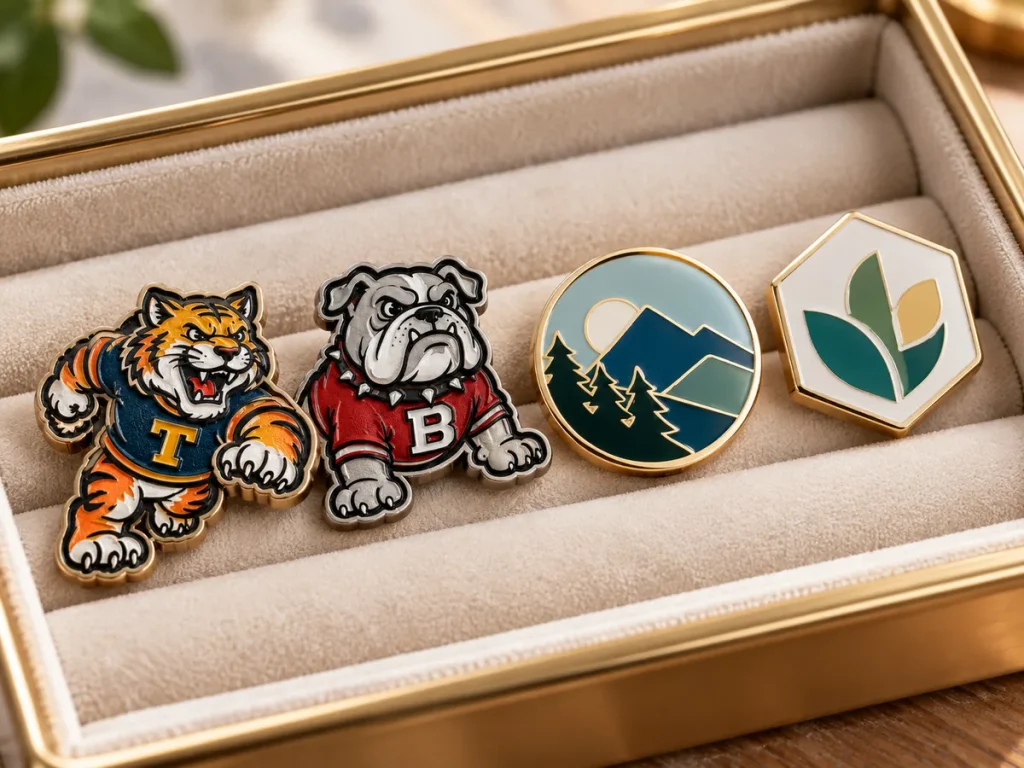
If you’re ordering custom pins for the first time, one of the first questions you’ll hear is “soft enamel or hard enamel?” Both are metal pins filled with colored enamel. Both can carry your logo, mascot or message beautifully. But they look and feel different, and they suit different projects.
This guide explains the difference between soft enamel and hard enamel pins in plain language, so you can pick the right one for your team, brand or event.
What enamel pins have in common
Before getting into the differences, it helps to know what both types share. Soft enamel and hard enamel pins start the same way:
- Your design is turned into production artwork, with every color area outlined by a thin metal line.
- A mold is made and the design is struck into a metal blank, creating raised lines and recessed areas.
- The pin is plated in a metal finish such as gold, silver, nickel, copper or black nickel (for hard enamel, plating usually comes after polishing).
- The recessed areas are filled with colored enamel, matched to your brand colors.
- A backing (usually a clutch) is attached.
The difference comes in step 4: how much enamel is used and how the pin is finished afterward.
What is a soft enamel pin?
With a soft enamel pin, the color is filled into the recessed areas but stays below the level of the raised metal lines. Run your finger over a soft enamel pin and you’ll feel the ridges between colors.
The look and feel
- Textured, dimensional surface. The raised metal outlines catch the light and give the design depth.
- Bright, saturated color. Soft enamel is great for bold, playful designs.
- Optional epoxy dome. A clear epoxy coating can be added on top. It smooths the surface, adds shine and protects the enamel, though you lose some of the textured feel.
Where soft enamel shines
- Trading pins for sports tournaments
- Event and conference giveaways
- School, club and fan pins
- Designs with fine text or small details, where the raised lines help separate colors
- Projects with larger quantities or tighter budgets
What is a hard enamel pin?
With a hard enamel pin, the enamel is filled up to the top of the metal lines (or slightly above), then polished down until the color and the metal are level. The result is smooth and flat.
You may also hear hard enamel called “imitation cloisonné” or “cloisonné-style.” True cloisonné uses glass-based enamel fired at very high temperatures; hard enamel gives a similar polished look with modern materials.
The look and feel
- Smooth, flat, polished surface. No ridges between colors.
- Jewelry-like finish. The polished metal lines look crisp and premium.
- Excellent durability. Because the surface is flat and polished, hard enamel resists scratches and everyday wear well.
Where hard enamel shines
- Corporate logo pins and employee recognition pins
- Years-of-service and award pins
- Association, union and membership pins
- Pins that will be worn daily on uniforms or jackets
- Gifts where a premium feel matters
Soft enamel vs. hard enamel: side-by-side comparison
| Feature | Soft enamel | Hard enamel |
|---|---|---|
| Surface | Textured, with raised metal lines | Smooth and flat |
| Finish | Matte or glossy color; optional epoxy dome | Polished, jewelry-like |
| Color | Very vivid | Rich and solid |
| Durability | Good; epoxy adds protection | Very good; resists scratches |
| Fine detail | Handles small details well | Very fine details may need simplifying |
| Budget | Usually the more affordable option | Usually costs more to produce |
| Best for | Events, trading pins, fun designs | Corporate, awards, everyday wear |
Exact pricing depends on your size, quantity, number of colors and options, so the only way to compare accurately is to quote both versions of your design.
How to choose between soft enamel and hard enamel
Ask yourself these five questions.
1. How will the pin be used?
A pin that will be traded, collected or handed out at a single event doesn’t need the same wear resistance as one worn every day on a work uniform. For short-term or high-volume uses, soft enamel is often the practical choice. For daily wear, hard enamel’s polished surface holds up better.
2. What image do you want to project?
Soft enamel feels fun, energetic and casual. Hard enamel feels polished, professional and permanent. Think about who will wear the pin and what it says about your organization.
3. How detailed is your design?
Soft enamel’s raised lines help separate small areas of color and tiny lettering. Hard enamel can also carry a lot of detail, but because the surface is polished flat, extremely fine elements sometimes need to be adjusted. A good proof will show you exactly how your design will look.
4. What’s your budget and quantity?
If you need a large number of pins or are working to a tight budget, soft enamel usually gives you more pins for your money. If you need fewer pins and want a premium piece, hard enamel is worth considering. Either way, ask for a quote on both so you can compare.
5. Do you want texture or shine?
Some people love the tactile feel of soft enamel; others prefer the glassy smoothness of hard enamel. If you like soft enamel’s look but want a smoother surface, ask about adding an epoxy dome.
Other pin styles worth knowing
Soft enamel and hard enamel aren’t the only options. Depending on your design, you might also consider:
- Die-struck pins: no enamel color at all, just the metal design with raised and recessed areas. Classic and elegant.
- Printed pins: the design is printed directly onto the metal, which is useful for photographs or gradients that can’t be done with enamel.
- 3D pins: sculpted metal with depth and contour, for mascots or detailed emblems.
- PVC pins: soft, flexible rubber pins in bright colors.
You can see these styles on our pages for soft enamel pins, hard enamel pins, die-struck pins, printed pins, 3D pins and PVC pins.
Finishing touches for both types
Whichever enamel you choose, a few details make a big difference:
- Plating color. Gold and silver are classic; black nickel makes bright enamel colors pop; antique finishes give a vintage feel.
- Backing. Rubber or metal butterfly clutches are standard. Magnetic backs avoid holes in delicate fabric. Locking backs help keep pins secure.
- Add-ons. Glitter, glow-in-the-dark enamel, translucent enamel, cutouts and moving parts can make a pin stand out. Tell us what you have in mind and we’ll confirm what works for your design.
- Packaging. A custom backing card turns a pin into a ready-to-give gift and gives you space for a message or your brand story.
Frequently asked questions
Is hard enamel better than soft enamel?
Neither is better in every case. Hard enamel is smoother and more durable for daily wear; soft enamel is more textured, very colorful and usually more affordable.
Can you feel the difference between soft enamel and hard enamel?
Yes. Soft enamel has raised metal lines you can feel. Hard enamel is polished flat and smooth.
Does soft enamel come off?
Soft enamel is durable for normal use. For extra protection, a clear epoxy coating can be added over the enamel.
Can I use my Pantone colors?
Yes. Enamel colors are matched to Pantone references, so share your brand colors when you request a quote.
Can I get the same design in both soft enamel and hard enamel?
Yes. Many designs work in both. Ask for a quote on each version and compare.
Get a quote for your enamel pins
Not sure whether soft enamel or hard enamel is right for your project? Send us your design or idea and we’ll recommend the best option for how your pin will be used. PINS makes custom lapel pins for companies worldwide and has its own offices in Mexico, Costa Rica, Chile and Argentina.